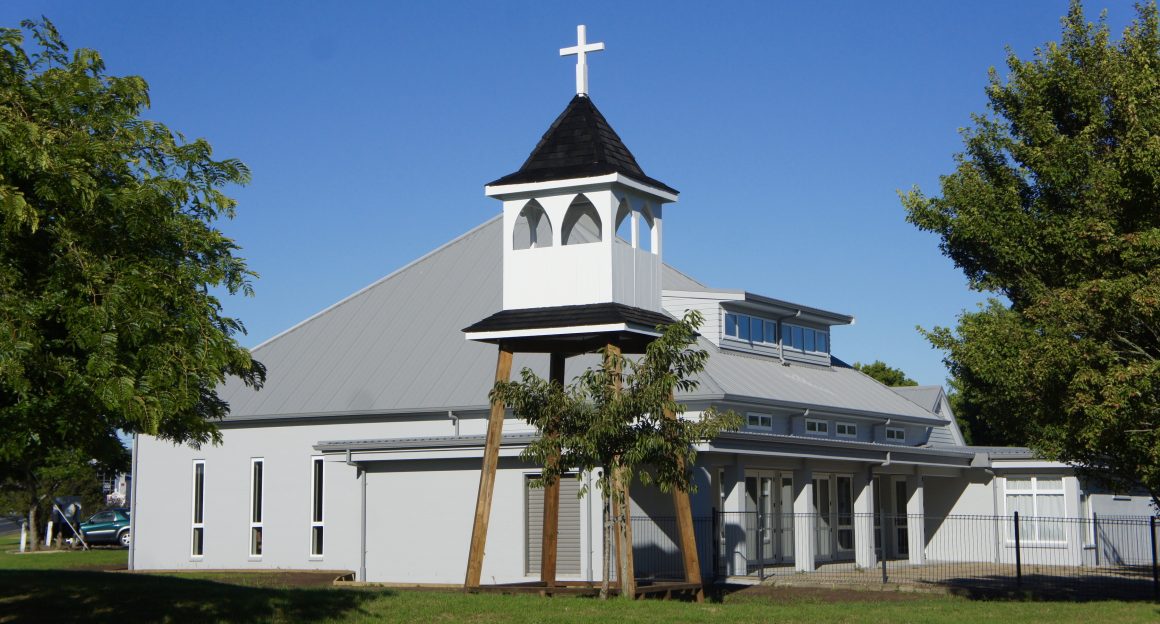
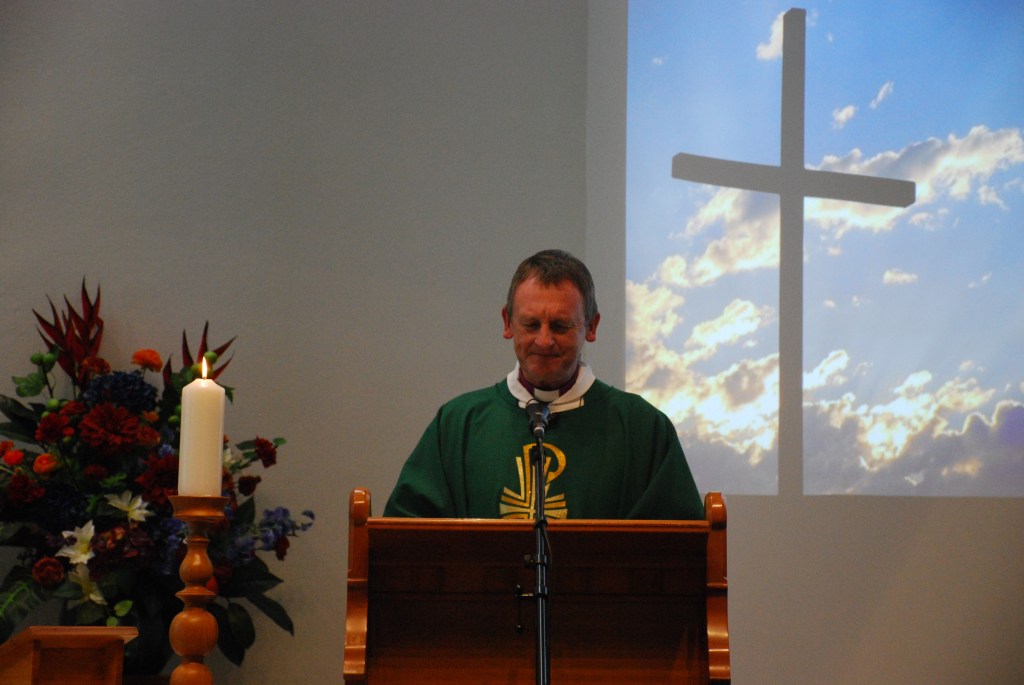
Bishop Ross preached for us this Sunday. Some of us were not in the service but heard that the message was very good, so , in case you missed out, here it is. He even joined in our KidsZone play about the parable Jesus told of the workers in the vineyard (Matthew 20.1-16).

Bishop Ross with some of the KidsZone group
Sermon on Sunday 24 September 2023 – Bishop Ross Bay
Readings: Exodus 16:2-15 and Matthew 20:1-16
It’s a demanding time for politicians. There are just three weeks until election day, or given early voting starts in a week there’s only that much time left to convince the early birds.
It’s a dangerous time for preachers. Those of us who believe that the substance of sermons cannot be disconnected from the reality of life cannot pretend that there isn’t a looming election and that there aren’t significant issues that the people of our country are facing and care deeply about. Preachers want to be true to that, but in a non-partisan way.
So, no party-political broadcast messages from me today – gone are the days of church leaders endorsing political leaders like (if any of you can remember) the Citizens for Rowling movement in the 1970s which had some strong Anglican backing.
As an aside I did decide to do the Vote Compass questionnaire just to see what some computer algorithms had to say about my politics. Apparently, I am far less left of centre than I thought I was, and in fact I am almost as centrist as you can be. Maybe all my years of episcopal diplomacy have taken their toll – or maybe even algorithms cannot make sense of the complexities of my political views.
Nevertheless, what do we have to say about today’s parable of the workers in the vineyard with its economic policy that looks like the living wage campaign on steroids? Whether a person had worked one hour or ten hours, their employer decided to pay them all the same. Modern employment contract law would (quite rightly) not allow people to be paid in such a way. The arguments put before the employer by those who had worked the full day, that they were being unfairly treated, would easily win the day in court.
Actually, I don’t think the parable is about economics or employment law. Instead, it is about the nature of the kingdom of God and is designed to tell people something about the “unfairness” of the generosity of God and the trust that people can place in God to attend to their needs.
Before we look into that though, let’s note some similar themes that emerge in the Exodus reading and what it might have to offer us as we interpret the parable. The Hebrew people have escaped from the slavery of Egypt, for which in the previous chapter there has been much rejoicing and thanksgiving, alongside a great sense of God’s victory over their enemies.
They have now embarked more fully on the journey that will take them to the promised land where they can settle and finally establish themselves as a people and fulfil all the hope of the promises which God gave to Abraham and Sarah so many years before.
No one had any idea just how harsh the reality of that journey would be, nor how long it would take them. Within days they had run out of water, and now a bit further on they are running short of food. We often popularise the idea of the Israelites in the wilderness being a moaning bunch, undermining Moses and with no faith in God. But put ourselves in their shoes and we probably would have been the same. Water and food are such basic essentials upon which life depends, and for those who lack them there is good cause for anxiety.
In both cases God hears their concern and provides for them. Today we read about the miracle of the manna which appeared daily as food for them. It is not fancy food (and after a while they become tired of it) but it provides daily sustenance – it is their daily bread, something for which we have been taught to pray.
But it is that – daily bread. It can’t be hoarded away and become a source of wealth and power to place one over another in this new society that God is creating. That was the way of things in Egypt where there were rich and poor, slave and free, domination and submission, power and powerlessness. The manna will keep them alive but is also a symbol of their new life and the society which they will build where there is a place for each one and where the needs of each one will be met. There is enough, but not too much. If you try to store it away it will rot before the morning.
There are shades of this in the parable. The people who work all day and the people who had little to do receive the same. It is enough for the day. In fact one denarius for a day’s work would have been barely enough but they would have survived.
Here’s an important detail in the parable that we don’t always see. The way of casual labour in 1st century Palestine is that someone needing workers for the day would go to the market place first thing to find those who were looking for work and would employ the number that they needed for the day. This landowner keeps returning to the market place and finding more people waiting with no work to do, and each time the landowner invites more to come and work.
There’s no hint that they are actually needed, but in generosity they are offered the chance to work. Neither is there a suggestion that they didn’t want to work or were too lazy to turn up earlier. When asked why they are there they answer that it’s because no one has hired them.
So it is that at the end of the day the decision is made to give them all the same, to provide them with what they needed for the day. So yes, it was unfair, and no, it’s not a model for good employment practices, but that’s not the point of the parable. That’s about the life of a new people that God is forming where the kinds of distinctions that create jealousy and domination, and so which separate people in unhealthy ways, are removed.
In offering that kind of vision and that insight into the nature of God and of God’s kingdom, light is also thrown on things as they are. Societies function with presuppositions about their values and structures where there will be winners and losers, insiders and outsiders, those who are honoured and those who are ignored or even shamed.
Hidden within the fairness of the complaint about the wages is an underbelly. It’s about more than just the money, for they say “you have made them equal to us.” Ah-hah! God seeks to be generous to all and to ensure that all have enough, but something within us wants to set ourselves above others and then those who establish that power get to decide what generosity will look like and what those without power and resources deserve.
It’s a dangerous parable because alongside presenting a vision of the divine society, it also exposes human aspiration which wants to build a different kind of society. How can it be that the last will be first, and the first will be last?
Let’s not pretend that we can actually build a society that’s about daily manna and the same day’s wages for all – just enough but not too much. Heavens, we can’t even build a church that looks like that!
But can we see the kinds of things to which God points us, the principles of a society where, even if some have more than they need it is also the fact that all have what they need; and when some are given authority over others it is used in a way to include and build up, not to dominate and exclude.
And if we believe that within these things is a vision of God’s kingdom (for which we pray to come on earth as in heaven), how will we live and how will we vote to be part of it coming in different ways for those who look for it from the point of greatest need? Because it’s not that to vote for one party or another in particular will necessarily achieve that, but that we vote in a way where we have some conviction that the good of our society as a whole will be advanced, and not just some within it.
Remember that we pray “give us this day our daily bread” not “give me this day my daily bread.” We need to seek ways that add to the common good, and don’t just secure our own place.
May the generosity of God, in all its unfairness, inspire us and guide us as we play our part in building a society that enables God’s kingdom to come.
Bishop Ross Bay

 Saint Chad's, Huapai